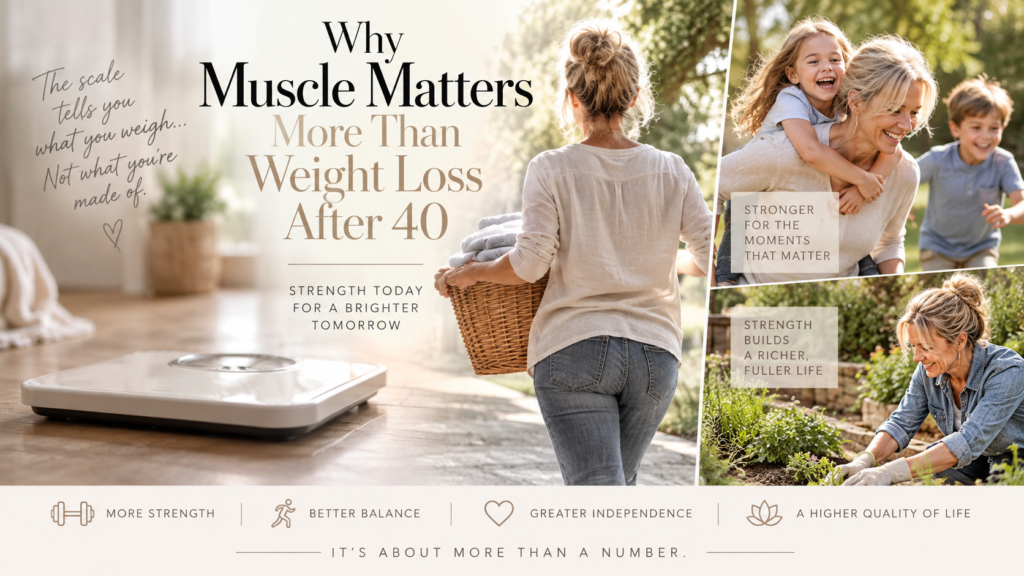
Why Muscle Matters More Than Weight loss After 40
For years, many of us believed the number on the scale was the best measure of whether we were healthy.
When the number went down, we felt successful.
When it stayed the same—or crept upward—we wondered what we were doing wrong.
We counted calories, bought low-fat foods, celebrated every pound we lost, and sometimes felt defeated by every pound we gained because we were taught the scale mattered most.
But the scale only tells one small part of the story.
Today, we know there are many other factors that influence how our bodies respond, including muscle mass, protein intake, activity level, hormones, sleep, stress, and the quality of the foods we eat.
The scale tells you what you weigh.
It doesn’t tell you what you’re made of.
⸻
A Shift in the Conversation
As I continued researching healthy aging, I kept seeing the same word come up again and again.
Muscle.
At first, I thought that sounded like something meant for athletes or bodybuilders.
But the more I learned, the more I realized this wasn’t about building bigger muscles.
It was about protecting something we all depend on every single day.
⸻
Maintaining Muscle Is About Living Your Life
When most of us hear the word muscle, we picture a gym.
Heavy weights.
Bodybuilders.
Fitness competitions.
But that’s not the kind of muscle we’re talking about.
Maintaining muscle is about protecting the life you’re already living—and helping you keep living it for years to come.
It’s what helps you carry a basket of laundry upstairs.
Lift bags of mulch into the garden.
Carry groceries into the house.
Play with your grandchildren.
Travel with confidence.
Maintain the balance and stability that help prevent falls as we get older.
Get up off the floor with ease.
Most of us don’t think about those things until they start becoming harder.
That’s why preserving muscle isn’t really about appearance.
It’s about maintaining the strength, confidence, and independence to keep living the life you’ve built.
⸻
Here’s What Happens As We Age
One of the things that surprised me most during my research was learning that we naturally begin losing muscle as we get older.
Not overnight.
Not all at once.
Little by little.
The challenge is that many of us don’t notice it happening because the bathroom scale doesn’t tell us.
Some women find that the scale hasn’t changed very much, but their clothes fit differently.
Others notice the scale slowly creeping up a few pounds year after year, even though their lifestyle hasn’t changed very much.
In both situations, your body composition may be changing in ways the scale alone can’t explain.
We’ve also learned that not all body fat is the same. Brown fat is more metabolically active than white fat, and discoveries around fat browning continue to expand our understanding of body composition and metabolic health. It’s one more reminder that healthy aging is about far more than the number on the scale.
You may have less muscle…
And more body fat…
Even though the number on the scale doesn’t tell the whole story.
The scale tells part of the story.
Your body tells the rest.
So… How Do We Maintain Muscle?
Here’s the encouraging part.
Maintaining muscle doesn’t require living at the gym or completely changing your life.
In fact, it’s often the small, consistent habits that make the biggest difference over time.
As I continued researching this topic, I kept seeing the same themes come up again and again.
Not quick fixes.
Not miracle supplements.
The basics done consistently.
⸻
- Eat Enough Protein
Protein provides the building blocks your body needs to repair and maintain muscle.
That’s one of the reasons it becomes even more important as we get older.
If you’re wondering how much protein you actually need—or whether you’re getting enough—I’ve written a separate article that takes a deeper dive into that topic.
⸻
- Keep Moving
You don’t have to become a bodybuilder.
You simply need to give your muscles a reason to stick around.
That might mean taking the stairs instead of the elevator.
Working in your garden.
Parking a little farther away.
Holding a heavy pot of water for a few extra seconds before placing it on the stove.
Or doing a few countertop push-ups while dinner is in the oven.
You don’t always have to find time to exercise.
Sometimes you simply need to recognize the opportunities to move that are already built into your day.
The goal isn’t perfection.
It’s continuing to challenge your body in ways that fit your real life.
Movement challenges your muscles. Recovery is what helps them adapt and stay strong.
⸻
- Give Your Body Time to Recover
One of the biggest surprises during my research was realizing that our bodies don’t simply rest while we sleep.
They rebuild.
During deep sleep, your body shifts into one of its most important recovery phases. It’s busy repairing tissues, supporting muscle recovery, balancing hormones, and preparing you for the next day.
Sleep also plays an important role in helping regulate cortisol, often called the body’s primary stress hormone. When cortisol stays elevated for long periods—whether from chronic stress, poor sleep, or both—it can make it harder to recover, support healthy metabolism, and maintain muscle over time.
Think of sleep as your body’s overnight maintenance crew.
You don’t become stronger while you’re walking, gardening, or exercising.
You become stronger because your body has the opportunity to recover afterward.
That’s one more reason healthy aging isn’t about pushing harder.
It’s about giving your body what it needs to rebuild.
- Build Habits That Fit Your Life
Healthy aging isn’t built in one workout.
Or one healthy meal.
It’s built through small habits that become part of your everyday life.
If you have an hour to exercise, that’s wonderful.
But if you only have five minutes today, those five minutes still matter.
Take a short walk.
Stretch while your coffee is brewing.
Practice sitting down and standing back up without using your hands.
Take a few extra trips carrying groceries instead of trying to bring everything in at once.
Small actions, repeated consistently, have a way of becoming part of who we are.
Progress doesn’t require perfect conditions.
It requires a place to begin.
⸻
Closing
For years, we measured success by watching the scale move.
Today, I think a better question is this:
Am I building the strength that allows me to keep living the life I love?
Healthy aging isn’t about becoming someone new.
It’s about protecting the strength, confidence, and independence that allow you to continue enjoying the moments that matter most.
The walks you want to take.
The gardens you want to plant.
The adventures you still want to experience.
The confidence to say “yes” when life calls.
The freedom to keep living life on your terms.
Start where you are.
Build one habit.
Then another.
Because the goal isn’t perfection.
It’s preserving the strength that allows you to keep writing your story for years to come.