
How to turn what’s already in your kitchen into dinner.
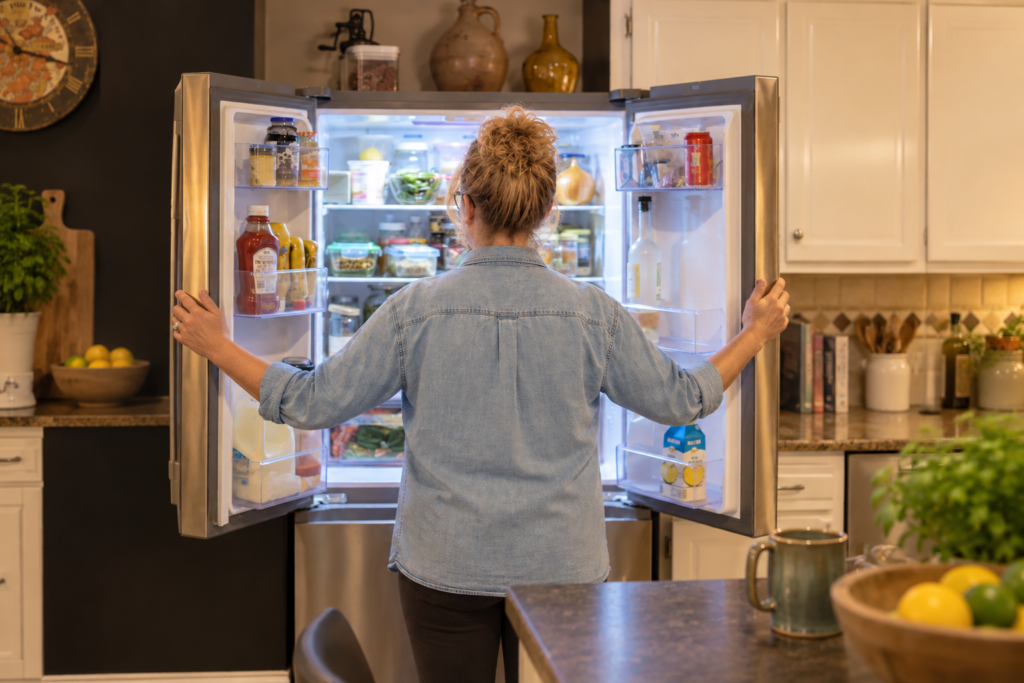
Have you ever opened the refrigerator…
Stared at everything inside…
Closed the door…
Only to open it again a few minutes later, hoping something different would appear?
I think we’ve all been there.
It feels like there’s nothing to eat.
Not because the refrigerator is empty.
But because we’re overwhelmed by too many choices, too little inspiration, or simply the mental energy it takes to decide.
For a long time, I thought I needed more recipes.
More ingredients.
More meal ideas.
I discovered something much more valuable.
I stopped thinking,
“What should I make?”
And started asking,
“What is my kitchen trying to tell me?”
That simple shift changed everything.
Most of us have been taught to start with a recipe.
I learned to start somewhere else.
Before I decide what I’m making,
I take inventory.
I open the refrigerator.
I check the freezer.
I glance through the pantry.
Not looking for a recipe.
Looking for clues.
Maybe there’s spinach that should be used soon.
Half an onion waiting for a purpose.
Leftover rice from two nights ago.
Fresh herbs that are almost begging to be picked.
A rotisserie chicken that can become something completely different.
Little by little, those ingredients begin introducing themselves.
Before long, a meal starts taking shape.
Not because I planned it.
Because I paid attention.
I’ve learned that my kitchen is always telling me a story.
I just have to slow down long enough to hear it.
Once I’ve taken inventory, I don’t try to figure out the entire meal.
I look for what’s already leading dinner.
Maybe it’s leftover grilled chicken.
Ground beef.
Soup.
Fresh salmon.
Vegetables.
Whatever catches my attention first becomes the starting point.
Everything else supports it.
While I’m making tonight’s dinner, something else usually starts happening.
I’m already noticing what tomorrow might become.
Maybe there’s enough chicken left for wraps at lunch.
Extra vegetables for soup.
Rice that could become fried rice.
Without even trying, I’m naturally beginning to think ahead.
You don’t have to force yourself to meal plan.
It simply becomes easier to see what’s next.
And that brings something we could all use a little more of…
Relief.
Once I discover what’s leading dinner…
I don’t immediately think about what I’m missing.
Instead, I move to what will support it.
If the salmon is leading dinner, maybe it needs asparagus and roasted potatoes.
If leftover chicken is leading, perhaps it becomes a salad or wraps.
If vegetables need to be used first, they may become the foundation instead.
The supporting ingredients reveal themselves much more easily once the main direction is clear.
Most meals don’t begin with a shopping list.
They begin with paying attention.
Only after I’ve taken inventory…
Discovered what’s leading dinner…
And built around what will support it…
Do I ask one simple question.
What’s missing?
Sometimes it’s a lemon.
Maybe milk.
Fresh parsley.
Or a loaf of bread.
Now my shopping list is short.
Specific.
Intentional.
Instead of filling the cart…
I’m simply filling the gaps.
I’ve found that approach saves money.
Reduces waste.
Makes dinner feel less overwhelming.
And somehow makes grocery shopping feel calmer too.
Because I’m no longer shopping for possibilities.
I’m shopping with purpose.
Fill the Gaps… Not the Cart.
I’ve always loved to cook.
That was never the problem.
The problem was what happened on my way home.
Like so many busy women, I’d leave work without taking inventory before I left the house.
I may not have actually needed groceries that day…
At all.
But because I hadn’t looked first, I’d stop at the grocery store anyway…
Just to make sure I had something to make for dinner.
Without realizing it, I’d start filling the cart.
Maybe another bag of lettuce.
Another carton of sour cream.
Another package of chicken.
Fresh herbs.
Vegetables.
Whatever seemed like a good idea in the moment.
Then I’d get home…
Open the refrigerator…
And realize I already had half of it.
That was where the waste began.
Not because I couldn’t cook.
Not because I didn’t care.
But because I hadn’t stopped to observe before I reacted.
Learning to take inventory before I shopped changed all of that.
Over time, I realized this wasn’t just changing the way I cooked.
It was changing the way I made decisions.
Instead of reacting to what I thought I needed…
I started paying attention to what was already there.
The more I practiced that way of thinking in my kitchen, the more I found myself using it in other parts of life.
I became less reactive.
More intentional.
Less overwhelmed.
More aware.
Sometimes the greatest source of relief isn’t buying something new.
It’s finally noticing what you already have.
That simple shift changed my kitchen.
But it also changed the way I approached everyday life.
An Invitation
The next time you open your refrigerator…
Don’t start by asking,
“What should I make?”
Pause.
Take inventory.
Look for what’s already leading dinner.
Move to what will support it.
Then simply fill the gaps.
You may discover that your refrigerator has been quietly giving you answers all along.
You just hadn’t learned how to read it yet.