How Often Should You Exfoliate Mature Skin?
What Actually Matters After 40

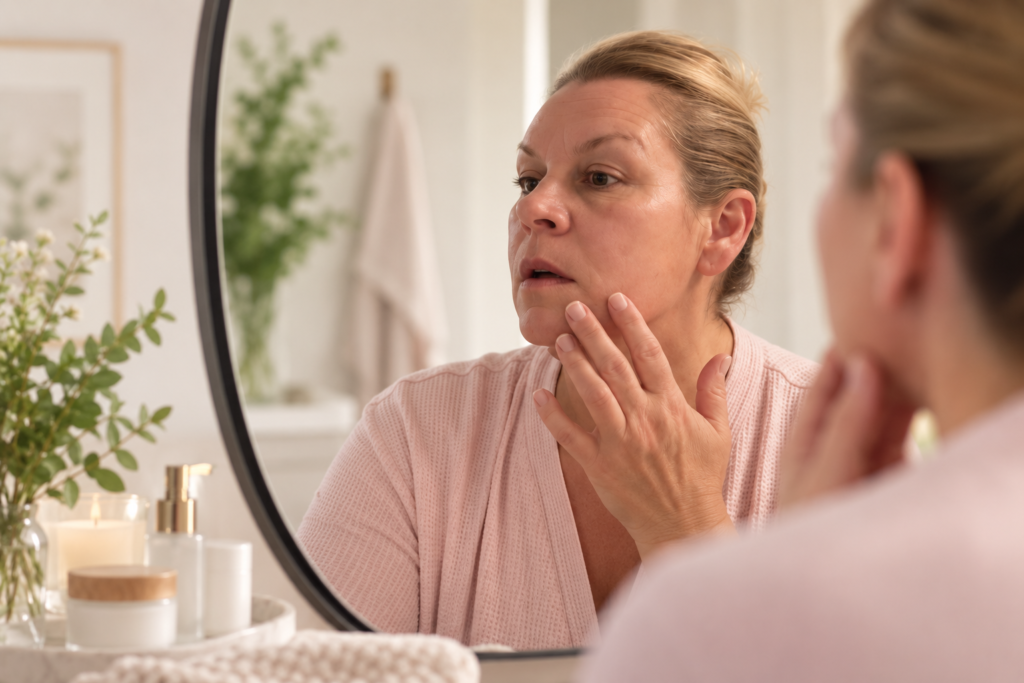
Woman over 40 examining mature skin in mirror

There was a time when exfoliation felt pretty simple.

Grab a scrub.

Use it a couple of times a week.

If your skin tingled a little, maybe that meant it was working.

If it peeled?

Well… apparently that meant it was really working. 😳

And then we hit our 40s and 50s and suddenly the rules don’t seem quite so simple anymore.

Skin can feel drier. A little more reactive. Texture may look different. Products you used for years may not feel the same.

So naturally, one of the first questions becomes:

Should I be exfoliating more now that my skin is older?

The answer is not a neat little number like “twice a week.”

And that’s actually good news.

Because your skin does not need another rule.

It needs you to understand what exfoliation is supposed to do—and how to know when you’ve done enough.


First, What Is Exfoliation Actually Doing?

Your skin naturally sheds cells from its outermost surface.

Exfoliation helps loosen or remove some of those surface cells that are ready to shed. That can make the skin feel smoother and improve the appearance of roughness, flakiness, dullness, or uneven-looking texture.

What exfoliation is not doing is stripping away a useless layer of “old skin” so brand-new young skin can suddenly appear underneath.

That outer surface is part of your protective barrier.

We want to refine it.

We do not want to wage war on it.


Yes, Skin Changes With Age. But That Doesn’t Mean “Exfoliate More.

 Skin renewal does tend to slow as we age.

That is real.

But there is no single turnover number that applies to every woman once she turns 40. Your skin does not wake up on your birthday and suddenly switch from one biological calendar to another. 😁

At the same time, mature skin can become drier and less tolerant of irritation.

That creates an interesting little paradox:

A rougher, duller-looking surface may sometimes benefit from thoughtful exfoliation…

while that same skin may be less forgiving when we overdo it.

So slower renewal does not automatically mean more exfoliation.

It means we need to be smarter about how we exfoliate.
 

So… How Often Should You Exfoliate Mature Skin?

Here is probably the least exciting—and most useful—answer:

There is no universal schedule.

Frequency depends on:

  • the type of exfoliation you’re using;
  • how strong or abrasive it is;
  • how your skin responds;
  • whether your skin is dry, sensitive, irritated, or compromised;
  • and what else you already have in your routine.

Your skin—not your birthday—should help determine the schedule.

A gentle method used lightly is not the same thing as a strong peel. A low-strength leave-on acid is not the same thing as an aggressive treatment.

This is why “How many times a week?” can never be the whole answer.


Physical Exfoliation

Physical exfoliation uses friction—a cloth, brush, polishing product, scrub, or tool.

The important question isn’t simply “How often am I using it?”

It is also:

“How rough is it—and how much pressure am I using?”

With physical exfoliation, technique matters just as much as frequency.


Chemical Exfoliation

Chemical exfoliants use ingredients that help loosen the bonds between surface cells or influence how those cells shed. This includes familiar ingredients like AHAs and BHAs.

But a mild leave-on formula and a stronger peel are not interchangeable. The acid, strength, formulation, how it is used, and what else is already in your routine all matter.

This is where I want women to stop thinking only in ingredients and start thinking in formulas.

The name of the ingredient is only part of the story.


Enzymatic Exfoliation

Enzyme-based exfoliants act on surface proteins rather than relying mainly on friction or acids.

Some people find them gentler-feeling, but “enzyme” does not automatically mean mild—and “natural” does not automatically mean non-irritating.

The formula matters. Your skin response matters.


Stronger Is Not Better

We have somehow been trained to think:

More tingle.

More peeling.

More scrubbing.

Better result.

No.

Sensation is not a scorecard.

Your skin does not have to sting, peel, or feel raw for a product to be effective.

A good exfoliation routine should leave skin feeling smoother and comfortable—not punished.

If your skin has to recover from your exfoliation routine, the routine may be working against you.


What Does Over-Exfoliation Look Like?

Watch for:

  • persistent stinging or burning;
  • redness or unusual tightness;
  • increased dryness or flaking;
  • tenderness;
  • products that suddenly sting when they never did before;
  • irritated or raw-feeling skin;
  • increased inflammation or breakouts.

Those aren’t little gold stars proving your exfoliant is powerful.

They are clues.

The goal is smoother skin—not proof that you exfoliated.


Your Skin Barrier Is Not Something You Need to Scrub Away

Your skin barrier helps protect against water loss and outside irritants.

Exfoliation intentionally changes part of that outer surface.

Done thoughtfully, that can improve roughness and help skin look smoother and more even.

Done too aggressively, it can create exactly what we were trying to fix: more dryness, sensitivity, irritation, and inflammation.

So instead of asking:

“How much can my skin tolerate?”

Ask:

“What is enough to improve the surface without disrupting what my skin needs to protect itself?”

That is a very different way of thinking.


But Doesn’t Exfoliation Help Skincare Penetrate Deeper?

This is one I hear all the time.

And… actually thought it was true myself.

Technically, changing the outer barrier can affect how easily substances pass through it.

But that does not mean:

“Exfoliate so all your skincare can penetrate deeper.”

Deeper is not automatically better.

Whether an ingredient reaches where it needs to go depends on the ingredient itself and especially how the product is formulated.

A smoother surface may help a product apply more evenly, but exfoliation cannot make a poorly formulated product suddenly work.

Here is the simpler version:

Exfoliation can improve the surface. Good formulation determines delivery.

That distinction matters.


Exfoliation and Structural Support Are Two Different Jobs

This is another distinction that matters after 40.

Exfoliation works at the surface.

It can help remove accumulated surface cells and improve the look and feel of roughness, dullness, and uneven texture.

But mature skin is changing in other ways too.

Clearing the surface and supporting the structure are two different jobs.

So I don’t expect an exfoliant to answer every concern I have about aging skin.

Sometimes the job is surface renewal.

Sometimes the job is targeted structural support.

And sometimes the smartest routine is simply understanding which job you’re trying to do before you add another product.

That is where the pieces start to make more sense together.


More Products Are Not the Answer Either

When something changes in our skin, our first instinct is often to add something.

Another serum. Another acid. Another mask. Another treatment.

Before adding anything, ask:

What job am I trying to accomplish?

Hydration? Barrier support? Exfoliation? Brightening? Targeted treatment? Sun protection?

And then:

Is my current routine already doing that job?

Because if it is, you may not need another layer.

This is where skinimalism makes sense to me.

Not:

Use fewer products because fewer is always better.

But:

Use fewer products because every product should earn its place.

Simplicity is the strategy.

Performance is the expectation.


Look at the Whole Routine

This is where people can accidentally build very aggressive routines.

A retinoid. An exfoliating acid. A scrub. Maybe a peel.

Each may be reasonable on its own.

The problem can be the combination.

Before adding an exfoliant, look at what you’re already using and how your skin is behaving right now.

This is why exfoliation cannot be treated as an isolated checkbox.

Your skin experiences the entire routine—not each product one at a time.

And if you use exfoliating acids—especially AHAs—sun protection becomes even more important.


So How Do You Know If Your Exfoliation Routine Is Working?

Does your skin feel like it is in harmony? That’s your clue

Skin that feels smoother. Looks a little brighter. Feels comfortable. Makeup sits better. Dry surface flakes are less noticeable.

You aren’t constantly thinking about your exfoliation routine because your skin isn’t protesting it.

That is a win.

You do not need drama. You need results your skin can live with.


Start With the Job

If you’re thinking about adding exfoliation—or changing what you already do—don’t start by asking:

“What exfoliator should I buy?”

Start here:

What am I noticing in my skin?

What am I trying to improve?

What am I already using?

How sensitive or dry is my skin right now?

And how is my skin responding?

Because trends will keep changing. Ingredients will keep getting renamed and repackaged. And there will always be another “must-have” treatment.

But once you understand what your skin actually needs, it becomes a whole lot easier to tell the difference between something that could help—and something that’s just another product.

And when something really does deserve a place in your routine, you’ll understand why.


How I Pair the Two

This is exactly why I pair two very different steps in my own routine.

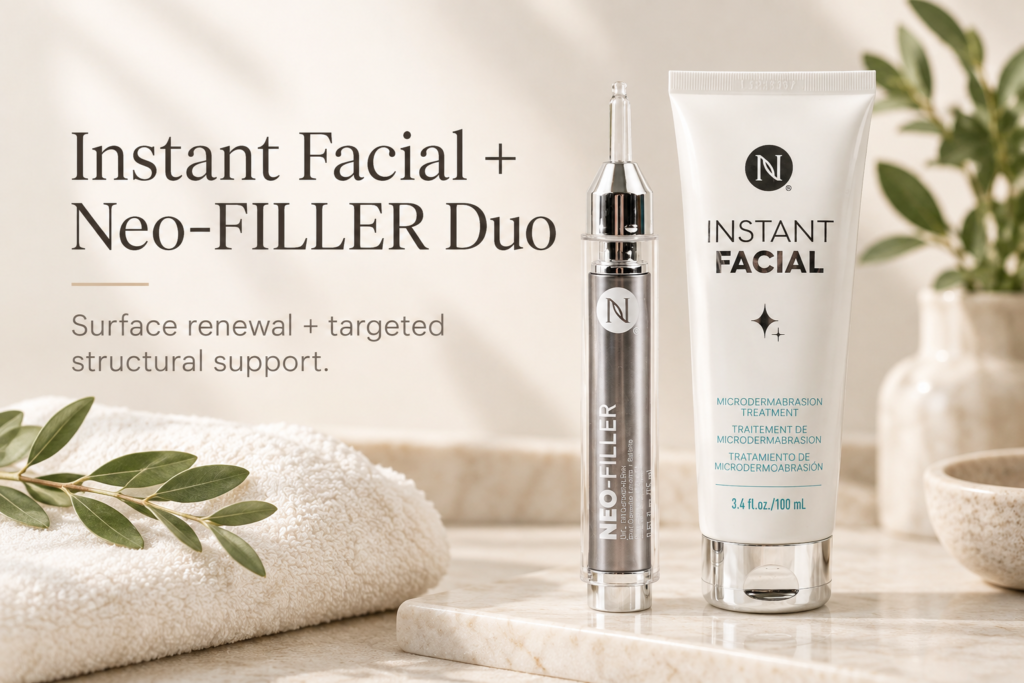
I use Instant Facial for the exfoliation piece—the surface-renewal step.

Then I use Neo-FILLER as my targeted structural-support step.

I’m not asking one product to do both jobs.

That pairing makes sense to me because I understand why each one is there.

Exfoliation can help clear the way. Supporting the skin afterward is a different job.

And that is really the kind of skinimalism I believe in:

Not fewer products just for the sake of having fewer products.

Fewer products with a very clear reason for being there.

Instant Facial + Neo-FILLER Duo

Surface renewal + targeted structural support, paired with purpose.

Neora Instant Facial and Neo-FILLER Duo displayed on a marble vanity with text highlighting surface renewal and targeted structural support

The Bottom Line

Mature skin does not automatically need more exfoliation.

It may benefit from the right exfoliation.

Match the method and intensity to your skin. Consider the rest of your routine. Respect the barrier. Pay attention to how your skin responds.

You do not need tingling.

You do not need peeling.

You do not need to scrub harder.

And you definitely do not need a universal schedule simply because you crossed a certain birthday.

More exfoliation isn’t better exfoliation.

Better exfoliation is intentional.

The goal is not to collect more steps.

It is to understand what your skin needs—and make sure every step earns its place.