
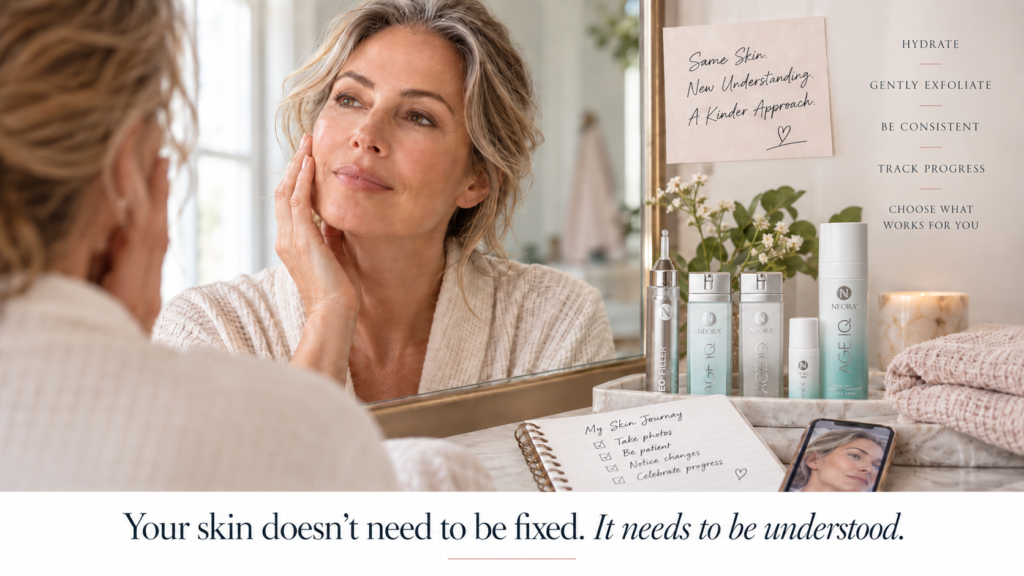
There comes a point when you look at your skin and think…
Wait. What happened?
The products you’ve used for years don’t seem to be doing what they used to.
Maybe your skin feels drier.
The texture looks different.
Maybe your makeup isn’t sitting the same way.
Or maybe you’ve already started buying more products, trying different routines, and wondering why nothing seems to be making much of a difference.
I’ve been there.
And after more than 35 years in the beauty industry, I’ll admit—it frustrated me.
Because I knew products. I knew ingredients. I knew beauty.
So naturally, I did what a lot of us do.
I tried more.
More creams.
More serums.
More promises.
And somewhere along the way, my bathroom started looking like a very well-stocked skincare graveyard. 
Half-used bottles. Products I forgot why I bought.
Oh—it was that buy one, get one 50% off deal that sounded so great at the time…
Things that sounded amazing in the store and somehow never became part of my actual routine.
But eventually I started asking a different question.
Instead of:
“What product should I try next?”
I started wondering:
“What if my skin has changed—and I’m still treating it like the skin I had years ago?”
That question changed the way I looked at skincare.
Because sometimes the answer isn’t another bottle.
Sometimes the first step is simply understanding what changed.
⸻
What Actually Changes in Your Skin After 40?
One of the biggest things I had to understand was this:
My skin wasn’t doing exactly what it did years ago.
As we get older, skin renewal generally slows down. Skin can become drier, feel rougher, look a little duller, and simply not respond the way it used to.
You may even notice things you never thought much about before.
Your makeup sits differently.
Your skin feels dry even though you’re moisturizing.
The routine you’ve used forever suddenly doesn’t seem to be doing much.
That doesn’t automatically mean your products stopped working.
And it certainly doesn’t mean something is “wrong” with your skin.
It may simply mean your skin has changed.
And this is where I think so many of us get stuck.
We keep using the same routine—or we start piling more products on top of it—without ever stopping to ask whether the routine still makes sense for the skin we have now.
That was the shift for me.
I stopped asking:
“What else can I add?”
and started asking:
“What does my skin actually need now?”
That question is a lot less glamorous than a shiny new serum.
But it’s a much better place to start.
⸻
So… What Does Your Skin Need Now?
This is where I used to make things harder than they needed to be.
I thought the answer was probably another product.
Something stronger.
Something newer.
Something with a prettier promise on the box. 
But what I really needed was a better way of looking at my routine.
For me, that started with two things:
helping my skin shed what it no longer needed
and
simplifying what I was putting back on it.
Not aggressively.
Not with ten new steps.
And definitely not with the idea that more must be better.
Just more intentionally.
That was a big shift for me because I had spent years thinking skincare was mostly about finding the right product.
What I eventually understood was that how I was caring for my skin mattered just as much as what I was buying.
And that brings us to the first piece:
Exfoliation — But Not the Way I Used to Think About It
For a long time, I thought exfoliation meant scrubbing.
You know the feeling.
If a little is good, surely a little more elbow grease will make it better.
Not exactly.
As skin changes with age, its natural renewal process can slow down. That can contribute to skin looking duller, feeling rougher, or simply not looking as fresh as it once did.
Exfoliation can help support that surface renewal.
But the lesson I had to learn was this:
The goal isn’t to strip your skin.
The goal is to support it.
And there isn’t one magic schedule that works for everyone.
What your skin tolerates depends on the type of exfoliation you’re using, the rest of your routine, how sensitive your skin is, and what else you may already be doing to it.
That was a much better way for me to think about exfoliation.
Not:
“How often should everyone exfoliate?”
But:
“What does my skin respond well to?”
That little change in the question makes a pretty big difference.
⸻
More Isn’t Better. Better Is Better.
This was probably the hardest lesson for me to learn.
Because when something wasn’t working, my instinct was usually to add something else.
Another serum.
Another cream.
Another step.
Pretty soon, I had products everywhere—and no real idea which ones were helping, which ones were unnecessary, or whether any of them were even working well together.
And I know I’m not alone there.
We’re surrounded by skincare that promises brighter, firmer, smoother, tighter, plumper, younger-looking skin.
So when our skin starts changing, it’s very easy to believe the answer must be more.
But more products don’t automatically create a better routine.
Sometimes they just create more decisions.
What helped me was simplifying.
Not because fewer products are automatically better either—but because I could finally understand what I was using, why I was using it, and whether it was actually earning its place.
That’s also when I started paying more attention to something I hadn’t thought much about before:
A good ingredient listed on the front of a bottle doesn’t tell you the whole story.
How a product is formulated matters too.
The amount of an ingredient, how stable it is, what it’s paired with, how it’s delivered, and how the entire formula works together can all influence what that product actually does.
That changed the way I shopped.
Instead of asking:
“Does this have the ingredient everyone is talking about?”
I started asking:
“Is this a well-designed product—and does it make sense for what I’m trying to accomplish?”
That’s a very different question.
And once my routine became simpler and more intentional, something else happened:
I actually stayed consistent with it.
Because the best routine in the world isn’t very helpful if it’s so complicated you stop doing it.
For me, simplicity wasn’t about doing less just to do less.
It was about making it easier to do the right things consistently.
And that may be one of the most underrated parts of skincare after 40.
You don’t need a crowded bathroom counter.
You need a routine you understand—and one you’ll actually use.
That was the bigger shift for me.
Once I understood that mature skin can be dealing with several things at the same time—hydration, barrier support, texture, visible firmness, and overall skin quality—it made less sense to keep chasing each concern with another random product.
My skin didn’t need another random product. It needed a smarter routine.
One where every step had a reason for being there, the pieces made sense together, and I could actually stay consistent with it.
Because more products do not automatically create better skin.
Sometimes what changes everything is finally understanding what each step is supposed to do.
⸻
The System I use
This is where my own routine began to change.
Instead of continuing to piece together one product for this concern and another product for that one, I moved toward a more coordinated approach.
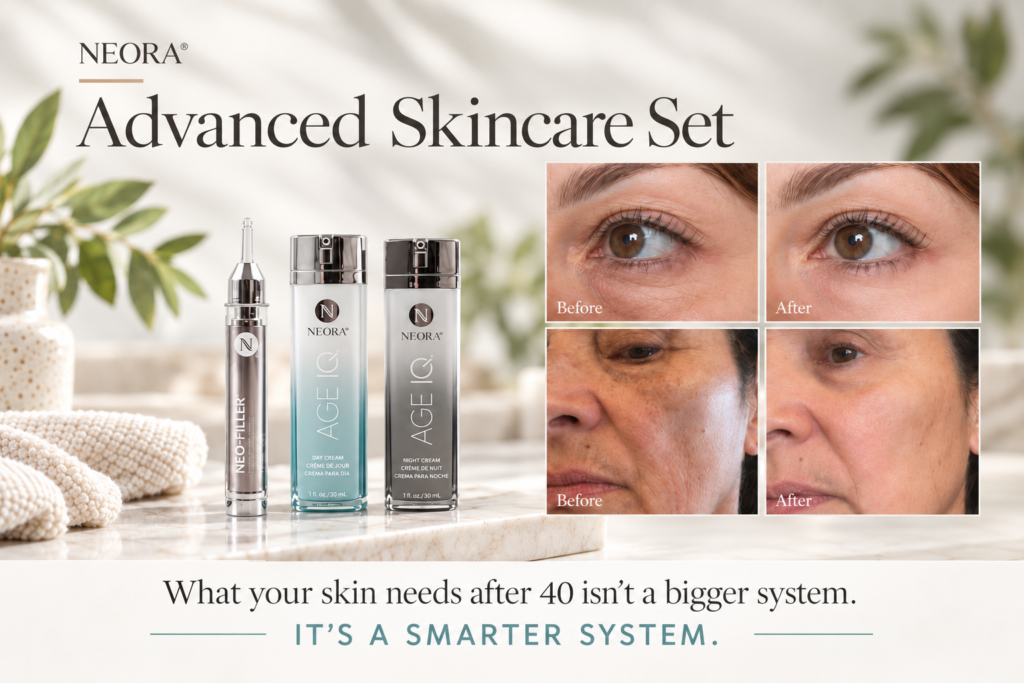
For me, that became the Neora Advanced Skincare Set.
What I value about using a system is not having more products.
It is having a routine where I understand why each step is there—and not constantly wondering what I should add next.
That also makes consistency much easier.
And if you’ve read anything from me by now, you know I would rather see someone use a thoughtful routine consistently than own a bathroom full of products they keep changing every few weeks. 
A smarter routine isn’t about doing more. It’s about making the steps you do take work together with purpose.
The coordinated skincare system I use when I want my routine to have a clear purpose instead of becoming a collection of random products.
This is where patience gets tested.
Because once we spend money on something and start using it, naturally we want to know:
Is this actually doing anything?
And I think skincare makes that especially difficult because we’re surrounded by dramatic before-and-afters, instant-result language, and promises that can make normal progress feel… well, a little boring.
But good skincare isn’t always about waking up one morning with a fresh, lifted face.
Sometimes the first changes are quieter.
Your skin feels more comfortable.
It doesn’t feel as dry by the end of the day.
The texture begins to feel smoother.
Your makeup sits a little better.
Your skin looks more hydrated or simply more like healthy skin.
Those things count.
And this is also where consistency matters.
Some products can create an immediate cosmetic effect. Others are designed to support changes that take longer to evaluate.
That’s why I now give a routine enough time before making decisions.
Not because there’s one magical biological clock that says every woman’s skin will completely renew itself in exactly 28, 60, or 90 days.
Skin doesn’t work by a universal stopwatch.
But 90 days can be a very useful window for something much simpler:
Consistency.
Did I actually use the routine regularly?
Did I give it enough time to observe a meaningful change?
And most importantly…
What change was I expecting to see in the first place?
Because if I bought something for hydration, I shouldn’t judge it by whether it lifted my jawline.
And if I’m trying to improve the appearance of uneven texture, I need to know what progress in texture actually looks like.
That sounds obvious when we say it out loud.
But how many times have we bought something because the overall promise sounded amazing without ever deciding what result we were actually looking for?
And there’s one more thing I’ve learned to do:
Take the picture.
I know. Roll your eyes…
The last thing we want when we’re unhappy with our skin is a close-up photo in good lighting.
But when you look at your own face every single day, gradual change can be incredibly hard to see.
You get used to what you’re looking at.
And memory isn’t a very good before picture.
So when I’m trying to evaluate whether something is truly working, I want a clear starting point.
Here’s what I do.
I take a clear photo or two when I start. Then I take another in the same lighting and setting every 30 days.
And I mark the product with the date I started using it.
Now I have something much more useful than:
“I think my skin looks better?”
I have something I can actually compare.
Maybe the texture looks smoother.
Maybe my skin looks more hydrated.
Maybe that area I was specifically watching looks different.
Or maybe I look at the pictures and realize…
Nothing meaningful changed.
That’s useful information too.
Because the goal of a before-and-after picture isn’t to convince myself something worked.
It’s to help me see more objectively whether it did.
So now, before I decide whether something has earned its place in my routine, I ask:
What did I want this to do?
Did I use it consistently enough to fairly evaluate it?
What changed—and what didn’t?
That gives me something much more useful than chasing the next promise.
It gives me information.
And information makes the next decision a whole lot easier.
The important takeaway is consistency—not chasing an exact number.
⸻
You Don’t Need to Start Over
By this point, you may be thinking:
“Okay… does this mean I need an entirely new skincare routine?”
No, not necessarily.
And please don’t go throw everything on your bathroom counter in the garbage.
That would completely miss the point.
The goal isn’t to replace everything.
It’s to start looking at what you already have with a little more understanding and intention.
What am I using?
Why am I using it?
What am I expecting it to do?
Is my skin responding well to it?
And does this product still make sense for the skin I have today?
Some things may absolutely earn their place.
Others may not.
And sometimes you may discover that what’s missing isn’t another product at all—it’s consistency, a better understanding of how to use what you already own, or simply recognizing that your skin’s needs have changed.
That’s a much calmer way to approach skincare than standing in front of a wall of products thinking:
“Which one of these is going to fix me?”
Because your skin doesn’t need to be fixed.
It needs to be understood.
And once you start there, choosing what belongs in your routine becomes a whole lot easier.
You’re no longer chasing.
You’re choosing.
⸻
Know What You’re Looking For
I still love discovering something new.
I still get excited about good ingredients, interesting formulations, and products that genuinely impress me.
I’m in the beauty industry. That part of me isn’t going anywhere.
The difference now is that I want to understand why something deserves a place in my routine before I give it one.
And that’s what I hope you’ll find here in the Beauty Room.
A place where we can look past the noise, understand what we’re being told, ask better questions, and figure out what makes sense for the skin we have now.
Because there will always be another ingredient trending.
Another product making an incredible promise.
Another reason to wonder whether we should be doing more.
We don’t have to chase all of it.
We can learn.
We can pay attention.
We can ask better questions.
And then we can choose.
Not because someone told us what we need.
Because we understand what we’re looking for.